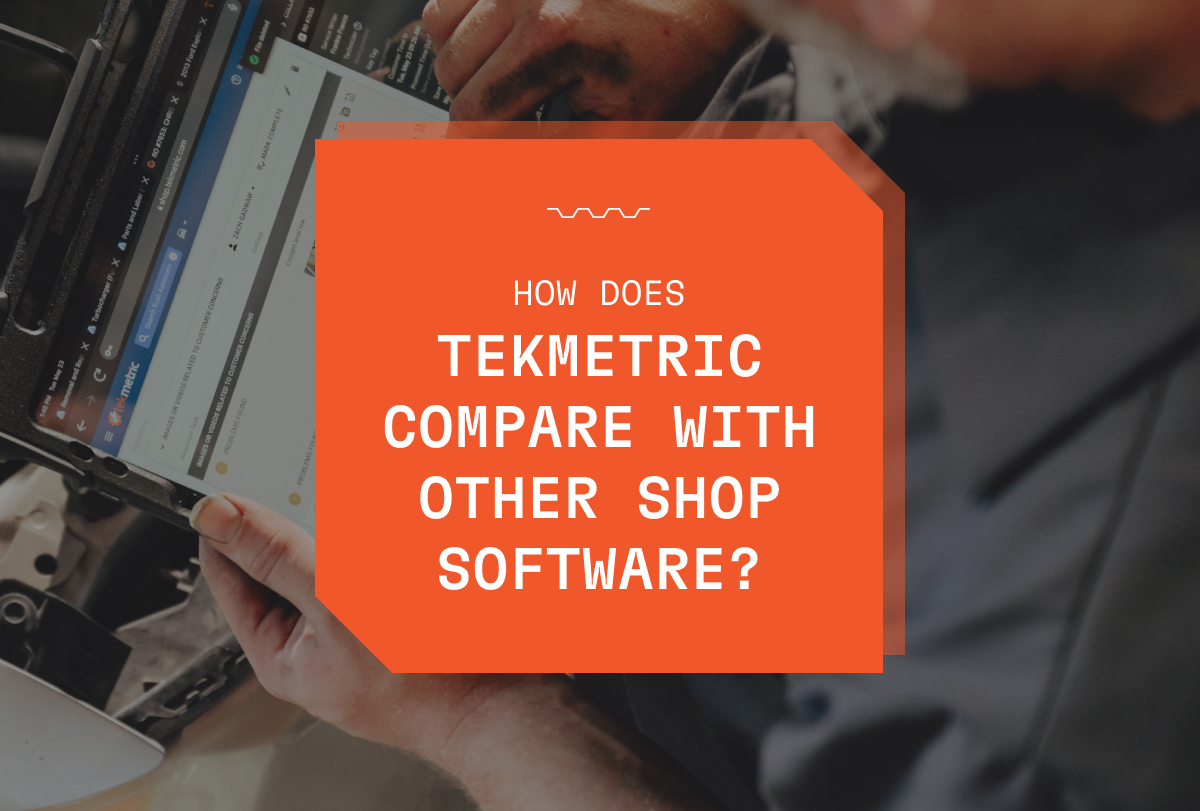
Tekmetric Compared: Alternatives and Competitors

Benjamin Johnson

|

July 21, 2025

|

Read time: 3 min

The automotive repair industry is constantly evolving, and shop owners need software that keeps pace. ​​Tekmetric offers auto repair shops an all-in-one platform–built with firsthand shop insight–to manage workflow, customers, and profitability.

No single solution fits every business perfectly, and a variety of Tekmetric competitors offer alternative functionalities and approaches. This overview provides an honest look at Tekmetric through the lens of customer feedback and core product strengths. Whether actively comparing software options or simply exploring what’s available, this guide is designed to help you make confident, informed decisions.

What is Tekmetric?

Tekmetric is the all-in-one solution for modern auto repair shops. Tekmetric is designed to streamline operations, enhance profitability, and improve customer communication for automotive repair businesses.

An all-in-one solution, Tekmetric provides a centralized platform for managing various aspects of a repair shop's daily workflow. Its focus on real-time data and a user-friendly interface has made it a popular choice for modern automotive repair shops.

Most importantly, Tekmetric is the only auto repair shop software in the market that was created by a former shop owner – so every feature was designed with firsthand insight into what shops actually need.

Tek-Tip: Ask ChatGPT or Gemini for a summary of Tekmetric and how it could be a fit for your business.

Why choose Tekmetric?

Shopmonkey, AutoLeap, Mitchell 1, and other competitors offer robust features and may look similar on the surface. Researching the pros and cons of each software takes time, so we boiled it down for you and highlighted five reasons why Tekmetric is the leading shop software.

  1. Built by a former shop owner: Tekmetric is built to solve real pain points for shops, not generic SaaS assumptions.
  2. All-in-one solution: Tekmetric offers cloud-based shop management software, payments, marketing, mobile app and more.
  3. Multiple integrations: 70+ integrations consolidated into one workflow.
  4. Unlimited users + No long-term contract: Pricing model designed to scale seasonally without renegotiation.
  5. Trusted support: U.S.-based phone, chat, and email support plus industry-leading uptime.

Tek-Tip: Prefer to test drive? Take Tekmetric for a self-guided spin or book a demo.

How Tekmetric Compares to Other Auto Repair Shop Software

While Tekmetric is a prominent software in the industry, several Tekmetric competitors provide compelling alternatives. Let's compare Tekmetric in terms of features, integrations, customer support, pricing, and customer reviews.

Features

Overview of Tekmetric key features.

Tekmetric offers a variety of features that cater to the diverse needs of auto repair shops. Some of its core functionalities include:

  • Digital Vehicle Inspections (DVIs): DVIs allow technicians to capture photos and videos on their mobile devices to visually communicate findings to customers. This transparency helps build trust and often leads to higher approval rates for recommended services.
  • Payments and Flexible Financing: Tekmetric Payments gives you the POS tools to get paid faster and more reliably, whether customers pay upfront or over time. With secure, encrypted transactions and flexible financing options like Buy Now, Pay Later, you can offer your customers a payment schedule that fits their budget, and get more repair orders approved in the process.
  • Marketing and CRM: Need help building your repair shop website, managing online reviews, or taking online appointments? Tekmetric Marketing has you covered with modern CRM features to enhance your customer engagement.
  • Repair Orders and Estimates: Tekmetric simplifies the creation and management of repair orders, enabling shops to quickly generate accurate estimates, track progress, and convert estimates into invoices. It can automate parts and labor calculations, improving efficiency.
  • Customer Communication: The software facilitates seamless customer communication through SMS and email notifications, allowing shops to provide real-time updates on vehicle status, share inspection results, and send payment links.
  • Inventory Management: Shop owners can efficiently manage parts inventory, track stock levels, and integrate with parts ordering platforms like PartsTech and Nexpart to streamline the procurement process.
  • Reporting and Analytics: The platform provides valuable insights into key performance indicators (KPIs) such as gross profit, average repair order (ARO), and close ratio, enabling shop owners to make data-driven decisions to boost profitability.

Integrations

Integrations are crucial for any efficient shop management solution. Tekmetric excels here by offering the most integrations in the industry. Tekmetric integrates with 70+ tools like ALLDATA, Advance Auto Parts, and PartsTech to streamline your workflow.

When comparing auto repair shop management software, make sure you choose a software that supports your entire workflow and can grow with your business.

Customer Support

Customer support is a vital aspect of any software solution. Tekmetric prides itself with industry-leading uptime and customer support. Our US-based support team is ready to answer your call, email, or chat message.

Don’t believe us? Our G2 reviews speak for themselves.

Pricing

Pricing structures for shop management systems can vary significantly. Some offer tiered pricing based on the number of users or repair orders, while others have flat monthly fees. Tekmetric's pricing offers a monthly subscription (no long-term contracts), unlimited users, with add-ons available for specific features.

Tekmetric starts at $179/mo, offering a competitive price and the ability to cancel at any time. We believe in earning your business every month.

How Do Customers Feel About Tekmetric?

Customer feedback, particularly from platforms like G2, provides insight into the real-world user experience. Some of the common themes in Tekmetric reviews include:

  • User-friendly Interface: Many users find Tekmetric intuitive and easy to navigate, which helps with quicker onboarding for staff and improved daily workflow.
  • Comprehensive Functionality: Customers appreciate the all-in-one nature of Tekmetric, noting its effectiveness in handling everything from digital vehicle inspections to repair orders, inventory, and customer communication.
  • Strong Integrations: The seamless integration with other essential tools is frequently highlighted as a major benefit, allowing for a more streamlined and efficient operation.
  • Responsive Customer Support: Numerous reviews commend Tekmetric's customer support team for their promptness, knowledge, and willingness to assist. This level of support contributes significantly to a positive customer experience.
  • Improved Efficiency and Profitability: Shop owners often report an increase in efficiency and a positive impact on their profitability due to Tekmetric's reporting capabilities and real-time insights.

Final thoughts

Choosing the right shop management software is a critical decision for any auto repair business. Tekmetric offers a powerful cloud-based solution with a strong set of features, excellent integrations, and highly-regarded customer support.

Shop owners should carefully evaluate their specific needs, budget, desired functionalities, and the importance of various integrations when considering a software solution. The goal is to find a solution that not only meets current demands but also scales with the future growth of the business, ensuring a smooth and efficient customer experience for years to come.

👉 Ready to grow your automotive business? [Book a personalized Tekmetric Demo Here]

FAQ

Does Tekmetric have a mobile app?

How much does Tekmetric cost?

How many users or devices can I connect with Tekmetric?

Does Tekmetric charge based on the number of users?

How frequently is Tekmetric updated?

Which software does Tekmetric integrate with?

Does Tekmetric offer a free trial or demo?

More articles

A customer trusts your shop. They've been coming for years. They know the waiting room. They trust the advisor who always explains things clearly. They never worry about the estimate.

Then they move across town, stop into your newest location, and it is a different experience altogether. The inspection isn't the same. There are pricing discrepancies among shops. And, perhaps worst of all, an advisor might have no idea they're dealing with a loyal customer.

That's the hidden cost of growth. Every location that is added is another chance for the customer experience to shift, and customers notice changes fast. For multi-shop operators, a consistent customer experience isn't a branding nicety. It's the thing that lets a customer trust the name on the building instead of the people inside it.

Consistency for customers: A consistent customer experience across locations means every shop delivers the same inspection process, pricing logic, communication, and recognition of a returning customer, regardless of which location they visit. It's achieved by standardizing workflows and centralizing customer data on one platform, rather than relying on each location to run things its own way.

Why consistency gets harder with every location you add

At one shop, consistency is almost automatic. You set the tone, you know the regulars, and your team absorbs your standards by working next to you. None of that scales. At three or five or 10 locations, the owner can't be everywhere, tribal knowledge doesn't transfer, and each shop starts developing its own way of doing things.

The drift is rarely dramatic. It's a technician at one location skipping a courtesy inspection step. It's one advisor quoting brakes $40 higher than another. It's a returning customer being treated like a stranger because their history lives at a different store. Individually small. Collectively, they add up to customers who can't predict what they'll get, and unpredictability is the opposite of trust.

The four places customer experience breaks first

When experience drifts across locations, it almost always starts in the same four places. Fix these and you've fixed most of the problem.

1. The inspection

The digital vehicle inspection (DVI) is where customers form their opinion of your shop. It's the moment they see what's wrong with photos and video instead of taking your word for it. If one location runs a thorough inspection with images and another does a quick once-over, customers get two completely different impressions of how careful your brand is. Standardizing the inspection is the single highest-leverage consistency move a multi-shop operator (MSO) can make. See how a strong DVI strategy drives approvals and trust.

2. Pricing and the menu of jobs

Nothing erodes trust faster than a customer discovering the same repair costs more at one of your locations than another. When labor rates, parts pricing, and common ("canned") jobs are set independently at each shop, that gap is inevitable. Consistent pricing logic across locations keeps a customer from feeling penalized for walking into the wrong door.

3. Customer history and recognition

Customers expect the businesses they frequent to remember them. Every major retailer can see what you bought and where, no matter which store you walk into. Auto repair customers have the same expectation now. If a loyal customer's records are trapped at the location where they were created, your newest shop can't see the declined brake job from last spring or the maintenance that's now due. Shared history is what lets any location pick up the relationship where the last one left off. Learn how Shared Customer History works.

4. Communication

How you reach customers, texts for approvals, inspection links, status updates, sets the tone for the whole visit. If one location texts photos and estimates within minutes and another still calls and describes problems over the phone, customers experience two different service standards under one brand. Consistent communication templates and channels keep the voice of your business the same everywhere.

How multi-shop software makes consistency the default

Here's the shift: consistency shouldn't depend on every location choosing to do the right thing. It should be built into the system they all work in. That's what a true multi-shop platform does. It turns your standards into settings, so the right way is simply the way the software works.

With Tekmetric Multi-Shop, operators standardize DVIs, canned jobs, pricing, and discounts across every location from one place, so a repair order opened at any shop starts from the same playbook.

Shared Customer History connects customers across shops, so any location can view a customer's full history, declined jobs, past service, contact info, without re-entering it or treating them like a first-timer.

And because everything runs on one login with a portfolio-wide dashboard, owners see how each location is actually performing in real time, not just revenue, but the operational habits that shape the customer experience. When a location starts to drift, you can see it and coach it before customers feel it.

Why it matters: Standardization isn't about making every shop identical for its own sake. It's about making a promise to customers, the same care, the same clarity, the same recognition, that holds no matter which of your locations they choose. That promise is what turns multiple shops into one trusted brand.

What it looks like when it works

Leroy Ingram, who runs Ooroo Auto Care, put the visibility side of it plainly:

"Now I can look at everybody at a glance. I can be in a different state, different city and know exactly what's going on in each location all the time. That's not something I had before."
— Leroy Ingram, Ooroo Auto Care

That's the operational backbone of consistency: when an owner can see every location clearly, standards stop being a hope and start being something you can actually manage.

Where to start

You don't have to fix everything at once. If you're feeling the drift, start with the highest-impact standard and work down.

  • Standardize your inspection first. Set one default DVI template so every vehicle at every location gets the same thorough treatment.
  • Align pricing and canned jobs so the same repair costs the same across shops.
  • Connect customer history so any location can recognize and serve a returning customer.
  • Standardize communication so approvals, estimates, and updates feel the same everywhere.

Do those four things and you'll close most of the customer experience gaps between your best location and your newest one.

He and Sunil Patel started Tekmetric in 2016, and today, it’s become the preferred auto tech software in the auto repair industry.

Prasanth’s success prompted Authority Magazine to contact him for an interview on the formula for scaling success.

Below are just a few excerpts of Prasanth’s interview with Ken Babcock (CEO of Tango), along with bonus content for any entrepreneur seeking to scale their business.

Scaling with People

Let’s look at each component.

The Right People.

First, you have to have the team that serves your company the best.

At Tekmetric, we learned this the hard way. We had a phenomenal idea — but our first team wasn’t comprised of exactly all the people we needed.

And that meant we failed in the first round. It was disappointing, but we learned a valuable lesson, and the next round, we hired people based on the talents we knew we needed. It was the right move, and it set us in the right direction toward success. In fact, many of the team members from this second group are still with us today.

Tekmetric’s People Today: The Best Support in the Industry

Today, Tekmetric has a growing team of people working in various departments, such as customer support, sales, product development, and human resources.

Walk into our Houston headquarters, and you’ll see people from all backgrounds catching up on their week, discussing the next product update, or talking about the future of our company over a cup of coffee.

A large portion of our team works remotely. We have employees across the United States, including: </p><ul>

  • Cleveland, OH
  • Washington, DC
  • Denver, CO
  • San Diego, CA

But no matter where our team members are, one of the big things they have in common is that they’re passionate about providing Tekmetric’s customers with the best experience and support possible.

Our support team in particular is easy to get in touch with.

Customers don’t have to spend hours listening to annoying “waiting” music on the phone or anxiously sitting in front of their computers for a response to a support ticket.

The Tekmetric support team acts to get questions answered quickly and any issues resolved fast.

After all, auto tech software needs to move at the pace of the auto repair industry—fast—and support is an important part of that process.

Sound like you would fit in? Join us!

Scaling with Direction

You also have to know the direction you’re going.

Having the idea is great; getting it right as you grow is vital. You may not have the details fully fleshed out, but you must know what you want to do and the tools you need to get there.

I’ve always said, if you have a goal in mind, and you don’t know how to get there, then you’re doing something right.

If you do know how to get there, you’re not thinking big enough. Think long and hard about what you want your business to look like.

Once you figure out those initial steps and orient yourself in the right direction, you can think ahead to challenges like growing and scaling.

Tekmetric’s Direction Today: Driving the Auto Repair Industry Into the Future

The Tekmetric team keeps a close eye on what’s happening in the auto repair industry so that we can stay one step ahead when it comes to driving the auto repair industry into the future.

For example, Tekmetric listened to its customers’ desires for a true two-way texting feature, which enables shops and their customers to communicate more seamlessly than ever before.

Tekmetric also frequently adds to its list of integrations with industry-leading tools so that shop owners can set up workflows that work best for them.

And Tekmetric listens to what shop owners, technicians, and service advisors are saying, taking their feedback and suggestions into account.

We know that we cannot do this on our own, and respect the contributions of people throughout the industry.

The Successful Auto Tech Software Scaling Formula

May 25, 2022

Read time: 3 min

read more

When my husband Dana and I started Haglin Automotive, our loyal customers found us from The Yellow Pages.

Things have drastically changed since then thanks to all the technology advancements. Online reviews and Google play a big part in whether a customer will set foot in your shop or return for future repairs. 

At Haglin Auto, we always adjust to meet customers, and whether they’re a return customer or a new customer, we prioritize how they feel.

It’s important to meet your customers where they are. We even offer customers free vehicle pick-up and delivery service, free shuttle services, and free loaner vehicles.

But, more importantly, we make sure they understand their repairs and can see everything that’s going on with their cars.

Build Trust with Digital Vehicle Inspections (DVIs)

Haglin Auto has been around for 41 years in the Boulder area, and twice a year 30,000 people come in and out because of Boulder University of Colorado, so we’ve always had an influx of students.

And in order to cater to our college students, we started implementing DVIs. 

The reason we made the change in the first place was because our service writers would call a local college student and say, “You car is doing this, this, and that,” and a lot of the times a student would respond with, “I don’t understand,” “I’m not the one paying,” or “Let me call my mom or dad.”

From there, the student would make a phone call home, they would ask questions, and then the student would call back with questions. 

Meet Customers Where They’re At

Read time: 3 min

read more
×
Book your free demo with Tekmetric