More than anything, partnerships should be mutually beneficial to everyone involved. When good partnerships are formed, the whole should be worth more than the sum of its parts.
Why Should Your Auto Business Partner with Other Brands?
For example, McDonald’s burgers make you thirsty enough to want a Coca-Cola, and sodas have a high margin. By partnering up, McDonald’s can lock in their costs on soda and improve their profit margins for the long term.
On the other hand, not all partnerships are beneficial. Partnerships can expand your opportunities but can also force you into making decisions you never intended to make. When McDonald’s decided to partner with Coca-Cola, they had to exclude other soda brands from their locations.
This exclusivity may have been worth it, but it meant removing options from customers, such as Dr. Pepper and Pepsi products. What may have made the partnership intriguing for McDonald’s is the fact that Coca-Cola owns a variety of beverages, including Diet Coke, Fanta, Sprite, Powerade, Minute Maid and Pibb Xtra.
Thanks to a variety of options, McDonald’s is able to satisfy most customers who ask for a Dr. Pepper by saying, “Will Pibb Xtra be okay?”
Partnerships in the Auto Repair Industry
In the auto repair industry, we face similar challenges when it comes to partnering with other businesses and brands.
Potential partnerships may include teaming up with parts suppliers, software companies, marketing and trade show affiliates, and any other service, resource or tool that could potentially improve your shop. In some cases, these partnerships will help shop owners enhance performance, save costs and drive revenue.
Other times, auto partnerships may bind you to an agreement that doesn’t pay off.
Here are some questions you can ask yourself to determine whether a partnership is mutually beneficial or if they’re asking you for more than you’re getting in return.
1. Are You Free to Choose the Tools and Solutions You Want?
One sign of a bad partnership is being forced to do something you don’t want to do. If partnering with another company means taking valuable options off the table, then you may be at a disadvantage.
If your partner implies or directs you not to do business with their competitors because they would like for you to instead use their services or their partner’s services, think it through.
Before officially entering a partnership, imagine your shop one year, five years and ten years down the road. Where will it be then? What will happen if your shop grows? What if innovation has slowed down with your partner? Will you be allowed to innovate your business by using new tools and solutions that become available in the future?
If you’re restricted in a way that prevents you from innovating or adapting to market conditions by testing other products, tools, solutions, and software, you may be handcuffed and unable to compete with other shops.
2. What’s Your Time and Resource Commitment?
A good partnership, like any good relationship, takes time and commitment. Effective collaboration means spending some time up-front so that everyone can get on the same page. But your time is valuable, and the time you put in up-front may not always be worth it on the back end.
Some programs may require significant time dedicated to training, process adjustments or brand initiatives that don’t fit into your current business model. That time could be spent pursuing changes that truly enhance your business performance and align with your goals.
If it feels like you have to change your ways to be a member of an exclusive partnership program, you may be sacrificing more control for the benefit of your partner without an equal return.
Look back at our own BG Canned jobs -- there's no extra work on your end to include these products in your repair order process, making it a seamless and simple way to boost repair order value for both your business, and your partner.
3. Will Your Guests Care?
If your guests get something out of the partnership—whether it’s convenience, savings, or confidence in your products or services—then you may be getting real value out of the relationship as a shop owner. After all, a good relationship with guests is a critical factor when it comes to improving your bottom line.
Sometimes, partnerships such as parts programs can appear more powerful than they are because shop owners may see them as a seal of approval. A banner with a logo from a well-known brand in front of your shop may make you and your employees feel confident, but consider if it really impacts your guest experience.
We see this dynamic play out in gas stations and convenience stores.
It may make gas station owners feel good to have a big Phillips 66 sign or a Chevron logo above their pumps, but most drivers could care less and just need to top off their tanks. Partnerships that require certifications for auto repair shops may give you a feeling of officialdom or accomplishment, but the guest simply needs their car fixed at an affordable price and by a trustworthy crew.
If the majority of customers see no value in a branded partnership, and there are no direct enhancements or savings that can be passed on to them, the program may be lacking and not worth your time or resources.
4. Will Your Auto Partner Truly Care About Your Success?
When assessing a partnership, part of the analysis rests on the bottom line. Will your metrics improve thanks to the partnership? Or will your performance be negatively affected by the program?
A good partnership is based on trust and a mutual commitment to success. You can usually tell right away if your partner is truly committed to your shop or if your shop is just another tally in their sales ledger.
If a partner implies that it’s on you to reach a certain standard before they’re willing to consider working with you, or threatens to end the relationship without trying to help you overcome a hurdle, it might be in your best interest to reconsider or renegotiate partnership terms.
Auto Partnerships Support Your Success
In 2019, Tekmetric was selected by Christian Brothers Automotive to be their shop management system for all their locations. Christian Brothers took partnerships very seriously. After a grueling assessment of the top management systems, Tekmetric was selected.
When our team asked what helps them finalize their decision, they said it came down to this notion that they felt Tekmetric truly cared about their success.
Take it from the Christian Brothers Director of Strategy and Innovation:
Every time we walked away after talking to the people at Tekmetric, we would just say, ‘Man, this is awesome.’ We never had that with a lot of the vendors we worked with in the past
Learn More About Repair Shop Success
As an auto repair shop management solution, Tekmetric has long realized the importance of mutually beneficial partnerships.
We strive to give shop owners the freedom to integrate their marketing, communication, parts ordering tools and more directly into one management system because that makes it easier and more efficient for shop owners to run their businesses.
“Receipts.” We all know the literal meaning of this term—those pieces of paper or emails/texts a retailer sends you as proof of purchase, in case you want to exchange or return an item down the road.
In a casual sense, “receipts” also mean “proof” in the event of a dispute. For example, if your dog could talk and claimed he definitely did not steal the pizza from the picnic table, you could show him “receipts,” which could be a photo your astonished friend snapped of him while he was dragging the pizza away. Busted!
Ok, but in all seriousness, as a business owner, you interact with receipts in two ways:
You give receipts to your customers once their repair work is finished
You get receipts when you purchase items for your shop (like parts)
Even though receipts exist in practically every industry, there’s a huge difference between the receipts customers get from an auto repair shop versus the receipts they’d get from a restaurant or clothing store.
Look at it this way: you don’t go to a restaurant and get an estimate for how much your food will cost. You see the prices on the menu, order, and then pay at the end. But in the auto repair world, we have to scope out the work with an inspection and estimate. That’s where the shop and the customer come to an understanding of the repair work that will occur, and get a preview of the cost, before any work gets done.
Without a solid inspection and estimate process, there can be a higher risk of misunderstandings and miscommunications, which can diminish customer loyalty and lead to credit card chargebacks. For example, a customer could misunderstand the severity of the need for a repair and decline it when they get their estimate, and leave a negative online review that their car still has issues. Or, a customer could say they don’t want a particular repair, but a service advisor misunderstands them. The repair happens, and the customer is upset when they get the final bill because they’d communicated that they didn’t want the repair.
That’s why estimates and receipts are extra important in our industry—they protect shops and customers. They give your customers peace of mind; they have a record of what repair work they got done on which day, and how much they paid. And in the event of a customer claiming a certain repair didn’t happen on a particular day, you could pull up your copy of the estimate and the receipt and set the record straight. You won’t have to deal with a frustrating back-and-forth process that can stretch out for days.
But beyond literal receipts, there are other elements of safeguarding your business. After all, protecting your business isn’t just about protecting it from financial and legal standpoints, although those are two important areas. You also have to think about things like your team’s productivity, employee management, healthy margins, and more. Auto shop management software is a great core tool that can help you safeguard your shop from multiple angles.
Smart Jobs is a revolutionary new way to build jobs in Tekmetric with just one click. Shop management software, at its core, is meant to help you build jobs, and we wanted to streamline that process as much as possible. So that’s what we did!
Your typical repair order may have one or more jobs packaged together. Usually that requires a lot of clicking around to find the right labor rates, and the right parts, sourcing the parts you don’t have, and applying the right markup matrices, over and over again.
That means an extra click for every single step. If you ask us, that’s too many clicks.
The reality is that all shop management systems require far too many actions for what really should be a one-click process.
When we set out to create Tekmetric, we set out to revolutionize the independent auto repair industry. We wanted to simplify, yet maximize the work your shop does.
We’re certain you’ll love how much Smart Jobs does just that.
"Smart jobs is a must have, it'll speed up your service writing by a huge amount.” - Chris Chagnon, COO at the Cardinal Plaza Shell
In the world of tires and engine diagnostics, the most powerful tool in your automotive shop might not be in your toolbox—it might be online. For the modern auto repair shop, a professional website is no longer a luxury; it’s a necessity. It’s your 24/7 receptionist, your most compelling advertisement, and your digital front door.
But where do you start? The world of web design can feel as complex as a modern car's electrical system. This guide will navigate you through the complexities of website building and best practices to drive customers to your shop.
Why a website is essential for mechanics
In an age where the first step to solving a problem is a Google search, your customers are looking for you online. When a check engine light flashes or brakes start to squeal, their phone is the first thing they reach for. If you’re not there to be found, you’re handing business to your competitors.
1. Building trust: A professional car repair website acts as a digital handshake. It tells visitors that you are a legitimate, trustworthy auto repair business.
2. 24/7 Marketing engine: Your shop has closing hours, but your website works around the clock. It provides essential information like your location, auto services, and phone number. You can even add online scheduling features so you never miss a customer when they are ready to book.
3. Local search and SEO: A well-optimized website is critical for local SEO optimization. When someone searches "car repair near me," search engines like Google prioritize businesses with informative and mobile-friendly websites. A strong online presence puts you at the top of those results, making you the default choice for local customers in need. More on SEO later.
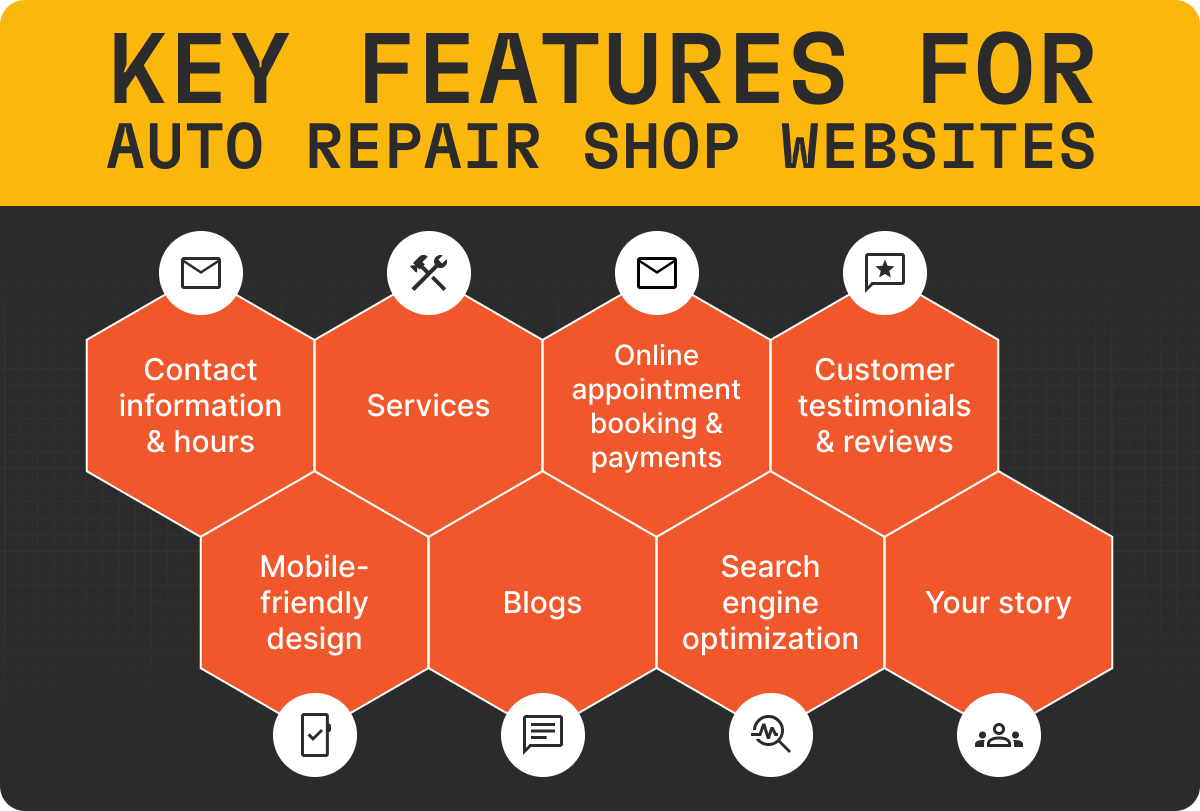
Key features for your auto repair shop website
To be effective, your mechanic website needs more than just a pretty face. It requires specific features and functionality to meet the needs of your customers.
1. Contact information and hours
Your phone number, address (with an embedded, clickable map), and business hours should be prominently visible on your homepage, preferably at the top and bottom of every page. A simple and memorable automotive shop name can also help you be easily remembered when the next check engine light comes on.
2. Add service pages
Don’t just say "we fix cars." Create distinct auto repair service webpages listing all of your car repair services: oil changes, brake repair, engine diagnostics, transmission services, tire rotation, auto care, etc. This not only informs customers but also provides valuable keywords for search engines and helps customers know if you perform the service they need. You can also include your prices if you think it is a selling point.
3. Online appointment scheduling and payments
Convenience is king. An integrated scheduling system that allows customers to select a service and schedule a time slot is a game-changer. It reduces phone tag, streamlines your workflow, and improves the overall customer experience.
Tek-Tip: Overwhelmed? Tired of boring website templates? Let Tekmetric build you a custom website that is tailored to your business. (Must be a Tekmetric customer).
4. Customer testimonials and reviews
Social proof is incredibly persuasive. A dedicated section for reviews from satisfied customers builds trust and validates your quality of work. An easy place to start is by managing and responding to your Google reviews.
5. Mobile-Friendly design
The majority of local searches happen on mobile phones rather than desktops. Your website must be optimized for mobile devices and fully responsive to provide the best user experience.
6. Blogs
Writing blogs about topics your customers care about can be an easy way to drive online engagement and new customers. Make your blogs specific to your geographical area such as “How to fix a flat tire in Houston, Texas” or “What to do when your check engine light comes on in Denver, Colorado”.
7. Search engine optimization
Stop what you are doing and search for your key automotive services in Google. Does your shop show up on the first page of Google? If not, you likely have an opportunity to optimize your SEO strategy and online presence.
8. Clear goals
Your website should make it easy for customers to contact you or to book an appointment. Whether you add a contact form or online booking functionality, make it easy for potential customers to start the process.
9. Your story
Is your shop veteran or family owned and operated? Sharing your story and what makes your shop unique can be a big selling factor for potential customers.
The best website builders for your shop
You don’t need to be a coding expert to build a website. Modern website builder platforms offer intuitive tools that make the process straightforward.
Tekmetric: If you are tired of boring website templates and are already a Tekmetric customer, Tekmetric will build you a custom website design that matches your brand and services. You can even add SEO support and online bookings so you can waste less time on marketing and spend more time with your customers. Best of all, everything syncs with your Tekmetric platform so everything stays in one place.
CAUTION: building your own website can be time consuming, expensive, and lead to poor results. Most website builders do not have automotive industry experience and may not know the best practices. Let Tekmetric build you a custom website that is tailored to your business. (Must be a Tekmetric customer).
Wix: If you want to invest the time and manpower to create your own website, Wix is known for its user-friendly drag-and-drop interface. It offers a wide selection of website templates, including many designed for the automotive industry.
Squarespace: Squarespace is another great option if you want to build your website yourself. Squarespace is known for its clean and modern website design templates.
Best auto repair website templates
Choosing a website design is about finding an aesthetic that reflects your brand and serves your customers' needs. Look for designs that are clean, professional, and easy to navigate. Here are a few of our favorite automotive websites:
The KARR website offers an engaging video on the home page paired with a bright aesthetic. It stands out to prospects with clear call-to-actions, customer testimonials, services, and contact information.
The Anderson website grabs your attention immediately with high-quality shop images with a minimalist aesthetic. We loved the easy to use online booking tool and embedded Google map for easy directions.
Hansen Auto Repair has done a great job making their website easy to navigate and incorporating clear call-to-actions. They added specific service level website pages to maximize SEO performance and even added coupons/warranty information. The theme is patriotic while also being professional.
The last website to make our list was an RV repair shop showcasing that all types of repair shops need a website to drive business. This website also stood out because they added a link to their merchandise store and helpful FAQs.
How to choose the right website design for your shop
With so many options, how do you pick the web design that's right for you?
Define your goals: What is the single most important action you want a visitor to take? Is it to call you? Book online? Visit your shop? Your entire design should guide them toward that goal.
Customer first: Are you serving busy parents who value convenience, or car enthusiasts who appreciate technical detail? Your design, from colors to fonts, should speak their language.
Brand identity: Your website is an extension of your physical car mechanic shop. If your shop is known for being modern and tech-forward, your website should reflect that. If you're a third-generation family business, your site should convey that heritage and trust.
Budget and resources: Consider both the initial cost and the long-term maintenance of the website.
Prioritize functionality: A beautiful website that is slow, confusing, or broken is worse than a simple website that works perfectly. Ensure the website template you choose is fast-loading and provides a seamless user-friendly experience for your visitors.
Final thoughts
Building a modern auto repair website is one of the single best investments you can make in the future of your automotive business. It establishes your credibility and works 24/7 to attract new clients.


.png)
.png)

.svg)


.svg)

.svg)
.svg)
.svg)
.svg)
.svg)
.svg)